Home EV charger installation in Spokane
You bought an electric car so you could stop thinking about fuel. Now you're planning your week around a public charger. We'll install a Level 2 charger so you can charge at home overnight.
About EV chargers
A lot of new EV owners in Spokane start out on a standard 120-volt outlet, which adds only a few miles of range per hour, or they sit at a public fast charger a couple of times a week. Neither is what you had in mind.
A Level 2 charger runs on a dedicated 240-volt circuit and can replenish a typical day's driving overnight. The questions most people get stuck on are whether the panel can handle it, which charger to buy, and where it should go. Those are exactly the things we sort out before any wire gets pulled.
You're probably ready for a Level 2 charger if…
- You're charging on a regular 120-volt outlet and it can't keep up with your driving.
- You're relying on public chargers and it's eating into your evenings.
- You have a second EV coming, or two drivers sharing one charger.
- You're buying or building a home and want it EV-ready from the start.
- You already have a charger, but it trips a breaker or the outlet runs warm.
What a proper EV charger install involves
Every home is different, but a charger install done right follows the same order: figure out what the house can support first, then install for that.
- Step 1
A load check on your panel
EV charging is a continuous load, so the circuit is sized with headroom. We look at your service size, what's already on the panel and how your home uses power, and tell you plainly whether the charger fits as is.
- Step 2
Choosing the charger and the circuit
Hardwired wall connector or a NEMA 14-50 receptacle for a plug-in unit? We'll talk through the trade-offs for your car and garage, including how fast you actually need to charge.
- Step 3
Routing it cleanly
The run from the panel to the charger is planned so it is protected, supported and tidy, whether that's through a finished garage, along an exterior wall or out to a detached garage.
- Step 4
Permit, install and inspection
A new 240-volt circuit needs an electrical permit. We handle it, install to the code as adopted in Washington, and the work is inspected before it's signed off.
- Step 5
Setup and a walkthrough
We set the charger's current limit to match the circuit, confirm it charges, and show you the breaker and the settings that matter.
Code, safety and permits
The details that keep a charger safe for years
A charger pulls a heavy load for hours at a time, night after night. That's why the shortcuts you sometimes see (an undersized wire, a cheap receptacle, a dryer-outlet splitter) cause problems.
Sized for continuous load
The breaker, wire and charger setting have to agree with each other. We size them for the charger you're actually installing, not a guess.
GFCI protection where it's required
Current code requires ground-fault protection on many garage and outdoor receptacles, including those used for EV charging. That affects whether a plug-in or hardwired charger makes more sense, and we'll explain why.
Outdoor-rated where it lives outside
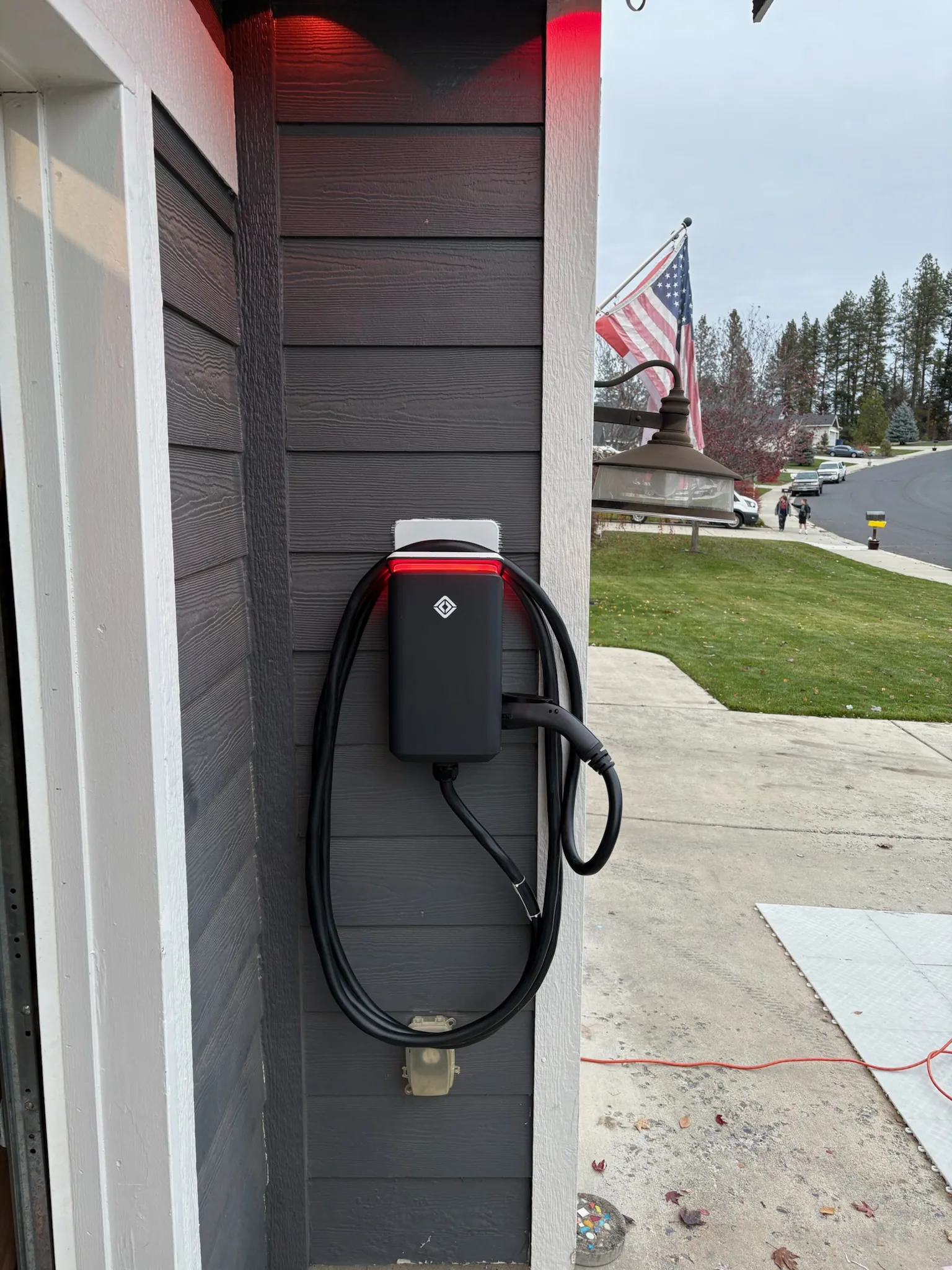
A charger on an exterior wall or driveway post needs a wet-location rating, sealed connections and protected wiring. Spokane winters find the weak points.
Options before a service upgrade
A tight panel doesn't automatically mean a service upgrade. Load management or a power-sharing charger can sometimes avoid one.
What shapes the scope of your install
Panel capacity
The single biggest factor. Room for a 2-pole breaker and enough service capacity keep it simple.
Distance from the panel
A charger right next to the panel is a different job than one at the far end of a detached garage.
Charger type
Hardwired units and plug-in units have different circuit and protection requirements.
Inside or outside
Exterior installs need weather-rated equipment and protected routing.
Questions people ask about EV chargers
Do I need a permit to install an EV charger in Spokane?
Yes. A new 240-volt circuit for a Level 2 charger needs an electrical permit and inspection: through the City of Spokane inside the city, and usually Washington L&I elsewhere. We pull the permit.
Hardwired charger or a NEMA 14-50 outlet?
Both work. Hardwired chargers such as the Tesla Wall Connector can often charge faster on the same panel, and they avoid some of the GFCI and receptacle-wear issues a plug-in setup can run into. A 14-50 outlet is flexible if you might change chargers. We'll recommend one based on your car and your panel.
Will I need a panel upgrade for an EV charger?
Not always. Many homes have the capacity already. If yours is tight, a load-management device or a charger set to a lower current can sometimes avoid an upgrade. If an upgrade is genuinely needed, we'll show you why.
Can you install a charger I bought online?
Usually, yes, as long as it's a listed product from a reputable manufacturer. Send us the model when you reach out so we can check it before the visit.
How long does an install take?
A straightforward install near the panel is often done in a day. Longer runs, detached garages or panel work add time. You'll know what to expect before we start.
Often part of the same project
Ready when you are
Tell us about your project.
Rather talk it through?
(509) 808-1925